

JN0-650 Free Certification Exam Easy to Download PDF Format 2026
Get 100% Success with Latest JNCIS-ENT JN0-650 Exam Dumps
Juniper JN0-650 Exam Syllabus Topics:
| Topic | Details |
|---|---|
| Topic 1 |
|
| Topic 2 |
|
| Topic 3 |
|
| Topic 4 |
|
| Topic 5 |
|
| Topic 6 |
|
| Topic 7 |
|
NEW QUESTION # 17
Which two statements correctly describe how EX Series switches use captive portal for Layer 2 authentication? (Choose two.)
- A. The captive portal authentication allowlist works for devices that do not have HTTP capabilities.
- B. The captive portal is the default Layer 2 authentication method that is applied before other methods such as 802 1X or MAC RADIUS.
- C. The captive portal is used as a fallback mechanism for clients that fail 802.1X or MAC RADIUS authentication.
- D. The captive portal is configured on Layer 3 interfaces and does not participate in Layer 2 authentication on EX Series switches.
Answer: A,C
Explanation:
In Junos OS 24.4, Captive Portal is used as a web-based authentication method for Layer 2 network access control, often in environments where 802.1X is not feasible for all users.
* Fallback Mechanism (Option D):On EX Series switches, Juniper supports aflexible authentication order. By default, the switch attempts authentication in the order of802.1X, thenMAC RADIUS, and finallyCaptive Portal. If a client fails both 802.1X and MAC RADIUS, the switch can fall back to Captive Portal to redirect the user to a login page.
* MAC Allowlist (Option B):Captive Portal relies on intercepting HTTP/HTTPS traffic to redirect users.
However, "headless" devices like printers or cameras lack web browsers and cannot interact with the portal. To accommodate these, Junos allows administrators to configure anauthentication allowlist(or whitelist), which identifies these devices by their MAC addresses and permits them to bypass the portal entirely.
* Precedence (Option A):This is incorrect because Captive Portal is generally thelastmethod in the default sequence, not the first.
* Layer 2 Participation (Option C):While Captive Portal requires a Layer 3 interface (RVI/IRB) for the redirection process, it is explicitly used to controlLayer 2 accesson EX Series switches.
NEW QUESTION # 18
Which statement accurately describes the role of a multicast RP, specifically when using the PIM sparse mode?
- A. The RP is responsible for forwarding all multicast traffic to all interfaces on the network, regardless of receiver interest.
- B. The RP is primarily used in the PIM dense mode to flood multicast traffic throughout the network periodically.
- C. The RP in the PIM sparse mode eliminates the need for any source-specific multicast (SSM) configurations.
- D. The RP functions as a central point where multicast sources announce their existence and receivers send join requests to start multicast sessions.
Answer: D
Explanation:
In PIM Sparse Mode, the Rendezvous Point (RP) serves as a central point where multicast sources register their existence and receivers send join messages to start receiving the multicast traffic. The RP ensures that multicast traffic is delivered efficiently only to networks with interested receivers.
NEW QUESTION # 19
When configuring OSPF. what is the purpose of adding the secondary command to an OSPF interface?
- A. The secondary command allows an interface to be in multiple areas.
- B. The secondary command creates an mtra-area backup path.
- C. The secondary command is used in conjunction with VRRP for failover.
- D. The secondary command sets a backup path for virtual links
Answer: A
Explanation:
In Junos OS, a physical or logical interface is typically associated with a single OSPF area. However, there are specific design requirements-such as migrating an interface from one area to another without downtime or creating specific transit topologies-where an interface needs to exist in two areas simultaneously.
* Multi-area Adjacency (Option B):The secondary command under the OSPF interface hierarchy allows an interface to be part of asecondary areain addition to its primary area.
* Protocol Behavior:When an interface is configured as secondary, the router sends and receives OSPF Hello packets for both the primary and secondary areas on that single link. This allows the router to form adjacencies with neighbors in both areas over the same physical connection.
* Use Case:This is frequently used in hub-and-spoke topologies or during network restructuring to ensure reachability is maintained while changing area boundaries. It effectively allows a "logical" split of the interface at the OSPF protocol level.
NEW QUESTION # 20
You are troubleshooting a BGP connection.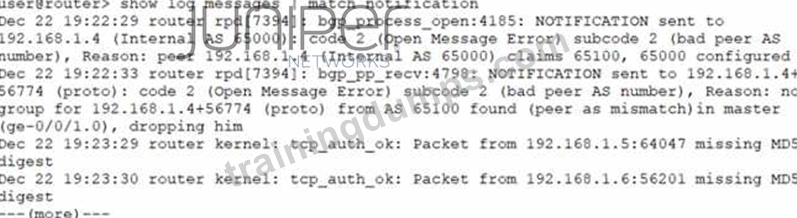
Referring to the exhibit, which two statements are correct? (Choose two.)
- A. Packet fragmentation is preventing the session from establishing.
- B. The ge-0/0/1 interface is disabled.
- C. The 192.168.1.5 peer has a misconfigured MD5 key.
- D. The 192.168.1.4 peer has a misconfigured autonomous system number.
Answer: C,D
NEW QUESTION # 21
You are asked to establish authentication for users connecting to the corporate network. You must ensure that only corporate devices that are identified by MAC addresses are allowed to authenticate and connect. Authentication must be handled by a centralized database. Which authentication method would you implement in this scenario?
- A. captive portal
- B. single-secure supplicant mode
- C. single supplicant mode
- D. MAC RADIUS
Answer: D
Explanation:
MAC RADIUS authentication allows only devices with predefined MAC addresses to authenticate and connect to the network. The authentication process is handled by a centralized RADIUS server, ensuring that only authorized corporate devices gain access.
NEW QUESTION # 22
You run a multivendor switching environment where you have configured VSTP. You have 450 VLANs and notice that some of your VLANs do not function properly. How should you change the configuration to get all 450 VLANs working?
- A. Include the force-version stp; statement in your configuration.
- B. Increase the bridge priority on all VLANs to at least 16k.
- C. Enable RSTP to handle additional VLANs.
- D. Set the VLAN max-age to 3600 or more.
Answer: A
Explanation:
In a multivendor environment, enabling force-version stp ensures compatibility with other vendors' STP implementations. By default, VSTP may not properly handle a large number of VLANs across mixed vendors, and forcing the STP version allows all 450 VLANs to function correctly.
NEW QUESTION # 23
Exhibit: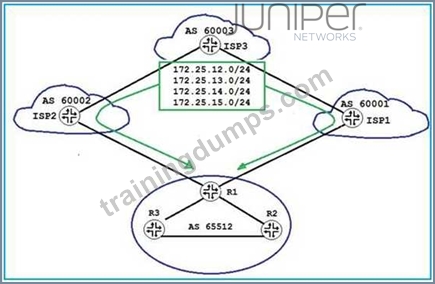
Referring to the exhibit, you are receiving multiple routes from ISP3 through two EBGP neighbors. You must ensure that all traffic leaving R1 destined to the networks advertised by ISP3 go through ISP2. What should you do on R1 to accomplish this task?
- A. Create and apply an import policy to set the route preference on routes learned from ISP2 to be lower than those learned from ISP1.
- B. Create and apply an import policy to set the local preference on routes learned from ISP2 to be higher than those learned from ISP1.
- C. Create and apply an import policy to set the local preference on routes learned from ISP2 to be lower than those learned from ISP1.
- D. Create and apply an import policy to set the route preference on routes learned from ISP2 to be higher than those learned from ISP1.
Answer: B
NEW QUESTION # 24
The connection between DC1 and DC2 is routed as shown in the exhibit.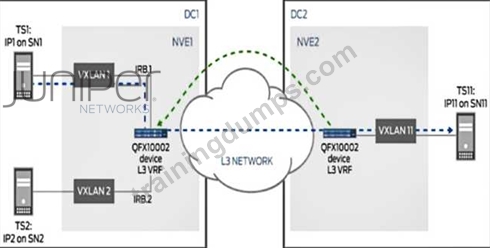
In this scenario, which statement is correct?
- A. Type 2 and Type 5 routes will be exchanged between DC1 and DC2.
- B. An IP prefix route provides encoding for intra-subnet forwarding.
- C. The border devices must be able to perform Layer 3 routing and provide IRB functionality.
- D. L3VPN must be enabled to advertise reachability.
Answer: C
NEW QUESTION # 25
Which of the following is NOT a function of OSPFv3?
- A. Advertises routes using BGP
- B. Utilizes LSA types that are different from OSPFv2
- C. Employs both intra-area and inter-area routing
- D. Supports IPv6 networking
Answer: A
NEW QUESTION # 26
What is the effect of the 'dampening' feature in BGP on a Junos device?
- A. It prevents the propagation of frequent route updates.
- B. It compresses BGP update messages to save bandwidth.
- C. It disables the exchange of keepalive messages.
- D. It increases the convergence time of BGP.
Answer: A
NEW QUESTION # 27
You configured MVRP in your Layer 2 network and you are adding two new interfaces to your distribution switch. You are asked to ensure that if a rogue device that uses MVRP is connected to these interfaces, that the MVRP PDUs are ignored In this scenario, what should you configure to accomplish this task?
- A. Configure the join-timer to 500 ms.
- B. Configure the two new interfaces as point-to-point.
- C. Configure the two new interfaces under MVRP using the forbidden registration mode.
- D. Configure the no-dynamic-vlan feature under MVRP.
Answer: C
Explanation:
To secure a Layer 2 network running Multiple VLAN Registration Protocol (MVRP) against unauthorized VLAN propagation from rogue devices, you must control the registration state of the ports.
Forbidden Registration Mode (Option D): This mode is specifically designed to prevent an interface from participating in the MVRP exchange.
When a port is set to forbidden, it will neither register nor declare VLANs (except those statically configured on the interface).
If a rogue device sends MVRP PDUs to this interface, the distribution switch will ignore those PDUs, preventing the rogue device from dynamically creating or learning VLANs through that port.
Registration Hierarchy: In Junos OS 24.4, this is configured at the [edit protocols mvrp interface < interface- name > registration forbidden] level.
Other Modes: normal (default) allows full participation, while restricted ignores joins for VLANs not already statically defined on the switch but still declares its own.
NEW QUESTION # 28
Exhibit: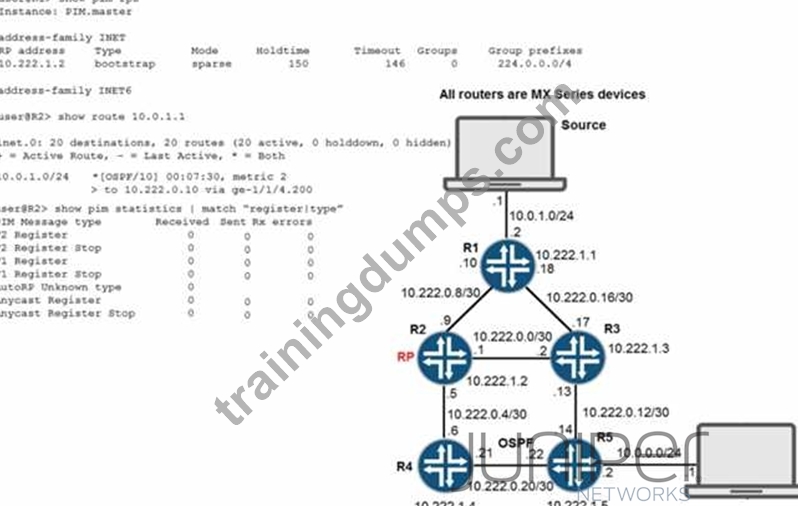
Referring to the exhibit, the source is currently sending multicast traffic using group 224.1.1.1, which is being received by R1. R2 is not receiving PIM register messages. What would be the cause of this problem?
- A. Tunnel services have not been enabled on R1.
- B. R5 has not received an IGMP report of 224.1.1.1.
- C. A(*,G) tree has not been built yet.
- D. All routers have not been configured with the same Auto-RP discovery group.
Answer: B
NEW QUESTION # 29
Which two statements are true regarding BGP load balancing? (Choose two.)
- A. Multipath provides per-flow load balancing.
- B. Multipath places multiple next-hops in the forwarding table for each destination.
- C. Multipath places a single next-hop in the forwarding table for each destination.
- D. Multipath provides per-prefix load balancing.
Answer: B,D
NEW QUESTION # 30
What is the primary function of the OSPF Area Border Router (ABR)?
- A. To redistribute routes from other routing protocols into OSPF
- B. To maintain separate link-state databases for each area it serves
- C. To connect OSPF areas to non-OSPF networks
- D. To advertise external routes into the OSPF domain
Answer: B
NEW QUESTION # 31
How is MSDP used in conjunction with PIM-SM?
- A. To enhance multicast traffic encryption
- B. To exchange multicast source information between PIM-SM domains
- C. To replace the need for an RP within a PIM-SM domain
- D. To optimize the multicast routing table size
Answer: B
NEW QUESTION # 32
How does Junos handle BGP route advertisements from a neighbor that include the local AS in the AS_PATH?
- A. It lowers the preference of the route.
- B. It replaces the received AS_PATH with the local AS.
- C. It accepts the route and adds the local AS to the AS_PATH.
- D. It rejects the route by default.
Answer: D
NEW QUESTION # 33
Which two statements are true regarding auto-RP? (Choose two.)
- A. It requires PMI Sparse mode only.
- B. It uses flood and prune in the network.
- C. It requires PMI Dense mode only.
- D. It requires both sparse and dense mode PIM.
Answer: B,D
NEW QUESTION # 34
Which attribute is commonly used in BGP to influence inbound traffic?
- A. MED
- B. Weight
- C. AS Path
- D. Local Preference
Answer: A
NEW QUESTION # 35
......
Get Ready to Pass the JN0-650 exam Right Now Using Our JNCIS-ENT Exam Package: https://vcecollection.trainingdumps.com/JN0-650-valid-vce-dumps.html
