NetApp Certified AI Expert Exam VCE dumps for simulated practice
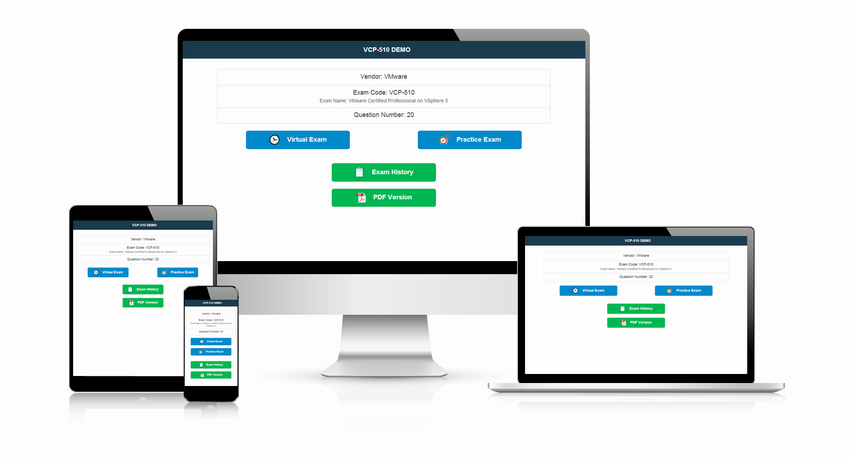
Except the pdf files, the NetApp Certified AI Expert Exam VCE dumps are popular and welcome in the choosing of the IT candidates. If you want to experience the VCE format, you can select the NetApp Certified AI Expert Exam pc test engine and online test engine as you like. In fact, NetApp Certified AI Expert NS0-901 VCE dump is a test simulator, which can bring you into a virtual real test environment. The interaction and intelligent properties of NetApp Certified AI Expert Exam VCE format training have attracted many candidates, and motivate the enthusiastic for study of the Network Appliance NS0-901 actual test. You can get scores after each test, and can set each test time as you like with the NetApp Certified AI Expert Exam VCE test engine. Besides, you can install it on your electric device and practice it at your convenience. Thus your spare time will be made full use of. With the simulated test engine, you can re-practice your test until you are sure to pass it. In addition, our NetApp Certified AI Expert Exam VCE test engine is virus-free engine, so you can rest assured to install it on your device.
Dear every one, trust our NetApp Certified AI Expert Exam training collection, you will get a high score in your first try.
Network Appliance NS0-901 Dumps Instant Download: Upon successful payment, Our systems will automatically send the product you have purchased to your mailbox by email. (If not received within 12 hours, please contact us. Note: don't forget to check your spam.)
Maybe you are a hard-work person who has spent much time on preparing for NS0-901 exam test. While the examination fee is very expensive, you must want to pass at your first try. NetApp Certified AI Expert Exam pdf vce dumps will provide you everything you will need to take for your actual test. The content of NS0-901 exam test are researched and produced by our senior experts who have rich hands-on experience in IT industry. The precise and logical are the requirement during the edition for NetApp Certified AI Expert Exam free demo torrent. From our NetApp Certified AI Expert study training, you will get knowledge different from books. Our NetApp Certified AI Expert Exam actual test dumps will help you not only pass in the first try, but also save your valuable time and energy. Now hurry up to get a boost in your career and get your NetApp Certified AI Expert Exam certification.

Original Questions and Verified Answers
Get the original questions and verified answers for your preparation about NetApp Certified AI Expert Exam training dumps, and 100% pass is the guarantee of our promise. We put the interest of customers in the first place. So in order to meet the needs of our customer, we strive for making the best valid and accurate NetApp Certified AI Expert Exam exam prep collection for all of you, and ensure you pass at first attempt with less time and energy investment. The NetApp Certified AI Expert NS0-901 questions are compiled from the original questions and checked and edited by our experienced experts. As we all know, it is not enough to ensure 100% pass just by the simulated questions, the accurate answers are very necessary for successful pass. While our NetApp Certified AI Expert Exam dumps prep answers can satisfy your requirement. The question answers are verified by vast data analysis and checked by several processes, thus the high hit rate can be possible. Choose our NetApp Certified AI Expert Exam free download training, you will not only gain a high test score, but also a broad spectrum of knowledge.
Network Appliance NS0-901 Exam Syllabus Topics:
| Section | Objectives |
|---|---|
| Topic 1: AI Infrastructure and NetApp Solutions | - Converged workloads
|
| Topic 2: Industry Use Cases | - AI applications across industries
|
| Topic 3: AI and Machine Learning Fundamentals | - AI, ML, DL concepts
|
| Topic 4: AI Lifecycle and Deployment | - End-to-end AI lifecycle
|
Network Appliance NetApp Certified AI Expert Sample Questions:
1. An organization wants to provide its data science team with a secure, on-demand method for using a powerful generative AI model with their private, sensitive corporate data. The solution must ensure that the private data is never exposed to the public internet or the public LLM API endpoint.
The architect is designing a solution using BlueXP.
Which two components are essential for building this secure solution? (Choose 2.)
A) The BlueXP GenAI Toolkit, which acts as a proxy to intercept user prompts and enrich them with data from a local vector database.
B) A direct VPN connection from each data scientist's laptop to the public LLM provider.
C) A private vector database hosted on an on-premises NetApp ONTAP system to store embeddings of the sensitive corporate data.
D) A BlueXP Connector deployed in a public subnet with a public IP address to allow access to the LLM.
E) A policy in BlueXP classification to copy all sensitive data to a public cloud bucket for easier access.
2. The AI training jobs on the AIPod are performing below expectations. The NVIDIA DGX servers' GPUs show low utilization. A performance analysis reveals that the bottleneck is not the storage system itself, but the network path between the storage and the compute nodes.
The current network configuration is as follows:
Network_Fabric: 100GbE Standard Ethernet
Protocol: NFS over TCP/IP
Data_Path: Storage -> Host CPU -> GPU Memory
Which network architecture enhancement would provide the most significant performance improvement by reducing latency and CPU overhead?
A) Upgrade the network switches to a model with a larger packet buffer.
B) Isolate the storage traffic on a separate VLAN from the management traffic.
C) Add more 100GbE network ports to the storage controllers.
D) Implement RDMA over Converged Ethernet (RoCE) and configure GPUDirect Storage.
3. An AI platform is suffering from poor performance during distributed training jobs. The training data resides on a single, large NFS volume. Monitoring shows that while the overall network throughput to the storage system is high, individual GPU nodes experience significant I/O wait times, and the single ONTAP volume is becoming a performance bottleneck. The goal is to re- architect the storage layout to maximize read parallelism and throughput for the training cluster.
Which two actions should the architect take to address this performance bottleneck? (Choose 2.)
A) Enable QoS maximums on the training volume to limit its IOPS.
B) Implement a NetApp FlexGroup volume to spread the dataset across multiple constituent volumes and aggregates.
C) Replace the NFS protocol with iSCSI for all training data access.
D) Increase the number of network ports connected to the storage controller.
E) Use NetApp FlexCache to create a local cache of the training data on each compute node.
4. A research institute is designing an infrastructure to support its entire AI drug discovery pipeline.
The pipeline has two distinct workload requirements:
1. Training: A team of data scientists needs to train several large transformer models simultaneously using a 500 TB dataset of genomic sequences. This process requires maximum data throughput to keep the GPUs saturated.
2. Inference: Once trained, the models are deployed to an internal web portal where researchers submit individual protein sequences for analysis. These queries must return results with the lowest possible latency.
Which infrastructure design best satisfies both requirements? (Choose 2.)
A) Use NetApp StorageGRID as the primary storage for both the training and low-latency inference workloads.
B) Deploy a large NetApp ASA cluster with GPUDirect Storage enabled for the training environment.
C) Use a single, large Cloud Volumes ONTAP instance in a public cloud to handle both workloads to simplify management.
D) Configure QoS minimums on the training volumes to ensure they do not impact inference performance.
E) Implement NetApp FlexCache on smaller nodes at the network edge to serve the inference requests.
5. An AI architect is designing a solution for a legal firm. The primary goal is to allow lawyers to ask natural language questions about case law stored in a private, 50 TB document repository.
The key project constraints are as follows:
Project_Goal: Answer questions using proprietary, real-time legal documents.
Constraint_1: Must not alter the foundational LLM's weights due to compliance.
Constraint_2: Case law database is updated daily with new rulings.
Constraint_3: All generated answers must be traceable to a source document.
Which technology should the architect choose as the core of this solution?
A) A new LLM trained from scratch on the legal documents.
B) A predictive AI model to classify legal documents.
C) A fine-tuning pipeline to update the LLM daily.
D) A Retrieval-Augmented Generation (RAG) architecture.
Solutions:
| Question # 1 Answer: A,C | Question # 2 Answer: D | Question # 3 Answer: B,E | Question # 4 Answer: B,E | Question # 5 Answer: D |


 Bertha
 Ives
Ives 
 Simon
Simon  Maggie
  John
John  Vincent
  William
  Darcy
Darcy 
 Pete
Pete  Maxine
  Nina
Nina  Marguerite
  Myron
Myron  Frank
Frank