

Updated Mar 18, 2026 Test Engine to Practice Test for 100-150 Valid and Updated Dumps
Exam Questions for 100-150 Updated Versions With Test Engine
NEW QUESTION # 18
What is the most compressed valid format of the IPv6 address 2001 :0db8:0000:0016:0000:001b: 2000:0056?
- A. 2001:db8: : 16: : 1b: 2000: 56
- B. 2001:db8: : 16: : 1b:2:56
- C. 2001:db8: 16: :1b:2:56
- D. 2001:db8: 0:16: :1b: 2000:56
Answer: D
Explanation:
IPv6 addresses can be compressed by removing leading zeros and replacing consecutive groups of zeros with a double colon (::). Here's how to compress the address 2001:0db8:0000:0016:0000:001b:2000:0056:
* Remove leading zeros from each segment:
* 2001:db8:0000:0016:0000:001b:2000:0056 becomes 2001:db8:0:16:0:1b:2000:56
* Replace the longest sequence of consecutive zeros with a double colon (::). In this case, the two consecutive zeros between the 16 and 1b:
* 2001:db8:0:16::1b:2000:56
Thus, the most compressed valid format of the IPv6 address is 2001:db8:0:16::1b:2000:56.
References :=
* Cisco Learning Network
* IPv6 Addressing (Cisco)
NEW QUESTION # 19
Which address is included in the 192.168.200.0/24 network?
- A. 192.168.201.13
- B. 192.168.1.13
- C. 192.168.200.13
- D. 192.168.199.13
Answer: C
Explanation:
*192.168.200.0/24 Network: This subnet includes all addresses from 192.168.200.0 to 192.168.200.255. The
/24 indicates a subnet mask of 255.255.255.0, which allows for 256 addresses.
*192.168.199.13: This address is in the 192.168.199.0/24 subnet, not the 192.168.200.0/24 subnet.
*192.168.200.13: This address is within the 192.168.200.0/24 subnet.
*192.168.201.13: This address is in the 192.168.201.0/24 subnet, not the 192.168.200.0/24 subnet.
*192.168.1.13: This address is in the 192.168.1.0/24 subnet, not the 192.168.200.0/24 subnet.
References:
*Subnetting Guide: Subnetting Basics
NEW QUESTION # 20
DRAG DROP
Examine the connections shown in the following image. Move the cable types on the right to the appropriate connection description on the left. You may use each cable type more than once or not at all.

Answer:
Explanation:
Explanation:
Based on the image description provided, here are the cable types matched with the appropriate connection descriptions:
Connects Switch S1 to Router R1 Gi0/0/1 interface Cable Type: = Straight-through UTP Cable
Connects Router R2 Gi0/0/0 to Router R3 Gi0/0/0 via underground conduit Cable Type: = Fiber Optic Cable
Connects Router R1 Gi0/0/0 to Router R2 Gi0/0/1 Cable Type: = Crossover UTP Cable
Connects Switch S3 to Server0 network interface card Cable Type: = Straight-through UTP Cable
The choices are based on standard networking practices where:
Straight-through UTP cables are typically used to connect a switch to a router or a network interface card.
Fiber optic cables are ideal for long-distance, high-speed data transmission, such as connections through an underground conduit.
Crossover UTP cables are used to connect similar devices, such as router-to-router connections.
These matches are consistent with the color-coded cables in the image: green for switch connections, yellow for router-to-router connections within the same rack, and blue for inter-rack connections. The use of these cables follows the Ethernet cabling standards.
Connects Switch S1 to Router R1 Gi0/0/1 interface:
Cable Type: Straight-through UTP Cable
A straight-through UTP cable is typically used to connect different types of devices, such as a switch to a router.
Connects Router R2 Gi0/0/0 to Router R3 Gi0/0/0 via underground conduit:
Cable Type: Fiber Optic Cable
Fiber optic cables are used for long-distance connections, such as those through an underground conduit between buildings.
Connects Router R1 Gi0/0/0 to Router R2 Gi0/0/1:
Cable Type: Crossover UTP Cable
A crossover UTP cable is typically used to connect similar devices directly, such as router to router connections.
Connects Switch S3 to Server0 network interface card:
Cable Type: Straight-through UTP Cable
A straight-through UTP cable is typically used to connect a switch to an end device, such as a server.
Straight-through UTP Cable: Used to connect different devices (e.g., switch to router, switch to server).
Crossover UTP Cable: Used to connect similar devices directly (e.g., router to router, switch to switch).
Fiber Optic Cable: Used for long-distance and high-speed connections, often between buildings or data centers.
Reference: Network Cable Types and Uses: Cisco Network Cables
Understanding Ethernet Cabling: Ethernet Cable Guide
NEW QUESTION # 21
A Cisco PoE switch is shown in the following image.
Which type of port will provide both data connectivity and power to an IP phone?
- A. Ports identified with number 6
- B. Ports identified with numbers 3 and 4
- C. Ports identified with number 7
- D. Port identified with number 2
Answer: A
Explanation:
In the provided image of the Cisco PoE switch, the ports identified with number 6 are the standard RJ-45 Ethernet ports typically found on switches that provide both data connectivity and Power over Ethernet (PoE). PoE ports are designed to supply power to devices such as IP phones, wireless access points, and other PoE-enabled devices directly through the Ethernet cable.
Ports:
* 2: Console port (for management and configuration)
* 3 and 4: Specific function ports (often for management)
* 6: RJ-45 Ethernet ports (capable of providing PoE)
* 7: SFP ports (for fiber connections, typically do not provide PoE) Thus, the correct answer is C. Ports identified with number 6.
Reference: =
* Cisco Catalyst 2960-L Series Switches Data Sheet
* Cisco PoE Overview
NEW QUESTION # 22
Move each cloud computing service model from the list on the left to the correct example on the right Note: You will receive partial credit for each correct answer.
Answer:
Explanation: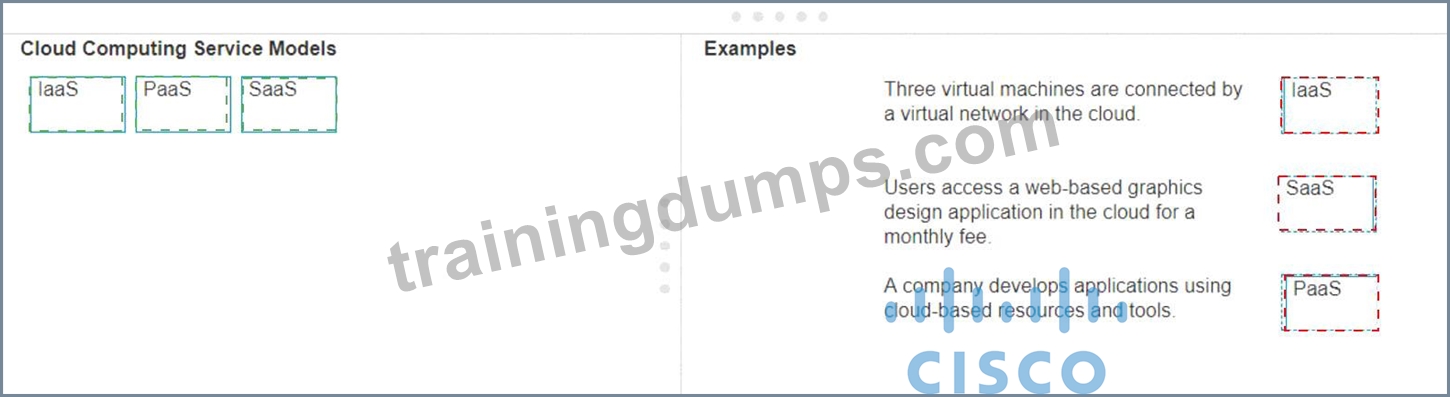
Explanation:
* Three virtual machines are connected by a virtual network in the cloud.
* Model: IaaS (Infrastructure as a Service)
* Explanation: IaaS provides virtualized computing resources over the internet, including virtual machines, storage, and networks.
* Users access a web-based graphics design application in the cloud for a monthly fee.
* Model: SaaS (Software as a Service)
* Explanation: SaaS delivers software applications over the internet, typically on a subscription basis, accessible via a web browser.
* A company develops applications using cloud-based resources and tools.
* Model: PaaS (Platform as a Service)
* Explanation: PaaS provides a platform allowing customers to develop, run, and manage applications without dealing with the infrastructure.
* IaaS (Infrastructure as a Service): Provides virtualized hardware resources that customers can use to build their own computing environments.
* PaaS (Platform as a Service): Offers a platform with tools and services to develop, test, and deploy applications.
* SaaS (Software as a Service): Delivers fully functional applications over the internet that users can access and use without managing the underlying infrastructure.
References:
* Cloud Service Models: Understanding IaaS, PaaS, SaaS
* NIST Definition of Cloud Computing: NIST Cloud Computing
NEW QUESTION # 23
A local company requires two networks in two new buildings. The addresses used in these networks must be in the private network range.
Which two address ranges should the company use? (Choose 2.)
Note: You will receive partial credit for each correct selection.
- A. 192.16.0.0 to 192.16.255.255
- B. 172.16.0.0 to 172.31.255.255
- C. 192.168.0.0 to 192.168.255.255
- D. 11.0.0.0 to 11.255.255.255
Answer: B,C
Explanation:
The private IP address ranges that are set aside specifically for use within private networks and not routable on the internet are as follows:
* Class A: 10.0.0.0 to 10.255.255.255
* Class B: 172.16.0.0 to 172.31.255.255
* Class C: 192.168.0.0 to 192.168.255.255
These ranges are defined by the Internet Assigned Numbers Authority (IANA) and are used for local communications within a private network123.
Given the options: A. 172.16.0.0 to 172.31.255.255 falls within the Class B private range. B. 192.16.0.0 to
192.16.255.255 is not a recognized private IP range. C. 11.0.0.0 to 11.255.255.255 is not a recognized private IP range. D. 192.168.0.0 to 192.168.255.255 falls within the Class C private range.
Therefore, the correct selections that the company should use for their private networks are A and D.
References :=
* Reserved IP addresses on Wikipedia
* Private IP Addresses in Networking - GeeksforGeeks
* Understanding Private IP Ranges, Uses, Benefits, and Warnings
NEW QUESTION # 24
During the data encapsulation process, which OSI layer adds a header that contains MAC addressing information and a trailer used for error checking?
- A. Data Link
- B. Network
- C. Transport
- D. Session
Answer: A
Explanation:
During the data encapsulation process, the Data Link layer of the OSI model is responsible for adding a header that contains MAC addressing information and a trailer used for error checking. The header typically includes the source and destination MAC addresses, while the trailer contains a Frame Check Sequence (FCS) which is used for error detection1.
The Data Link layer ensures that messages are delivered to the proper device on a LAN using hardware addresses and translates messages from the Network layer into bits for the Physical layer to transmit. It also controls how data is placed onto the medium and is received from the medium through the physical hardware.
Reference: =
The OSI Model - The 7 Layers of Networking Explained in Plain English
OSI Model - Network Direction
Which layer adds both header and trailer to the data?
What is OSI Model | 7 Layers Explained - GeeksforGeeks
NEW QUESTION # 25
You need to connect a computer's network adapter to a switch using a 1000BASE-T cable.
Which connector should you use?
- A. OS2 LC
- B. Coax
- C. RJ-45
- D. RJ-11
Answer: C
Explanation:
* 1000BASE-T Cable: This refers to Gigabit Ethernet over twisted-pair cables (Cat 5e or higher).
* Connector: RJ-45 connectors are used for Ethernet cables, including those used for 1000BASE-T.
* Coax: Used for cable TV and older Ethernet standards like 10BASE2.
* RJ-11: Used for telephone connections.
* OS2 LC: Used for fiber optic connections.
Reference: * Ethernet Standards and Cables: Ethernet Cable Guide
NEW QUESTION # 26
Which protocol allows you to securely upload files to another computer on the internet?
- A. SFTP
- B. ICMP
- C. NTP
- D. HTTP
Answer: A
Explanation:
SFTP, or Secure File Transfer Protocol, is a protocol that allows for secure file transfer capabilities between networked hosts. It is a secure extension of the File Transfer Protocol (FTP). SFTP encrypts both commands and data, preventing passwords and sensitive information from being transmitted openly over the network. It is typically used for secure file transfers over the internet and is built on the Secure Shell (SSH) protocol1.
Reference: =
* What Is SFTP? (Secure File Transfer Protocol)
* How to Use SFTP to Safely Transfer Files: A Step-by-Step Guide
* Secure File Transfers: Best Practices, Protocols And Tools
The Secure File Transfer Protocol (SFTP) is a secure version of the File Transfer Protocol (FTP) that uses SSH (Secure Shell) to encrypt all commands and data. This ensures that sensitive information, such as usernames, passwords, and files being transferred, are securely transmitted over the network.
* ICMP (Internet Control Message Protocol) is used for network diagnostics and is not designed for file transfer.
* NTP (Network Time Protocol) is used to synchronize clocks between computer systems and is not related to file transfer.
* HTTP (HyperText Transfer Protocol) is used for transmitting web pages over the internet and does not inherently provide secure file transfer capabilities.
Thus, the correct protocol that allows secure uploading of files to another computer on the internet is SFTP.
Reference: =
* Cisco Learning Network
* SFTP Overview (Cisco)
NEW QUESTION # 27
HOTSPOT
You want to list the IPv4 addresses associated with the host name www.companypro.net.
Complete the command by selecting the correct option from each drop-down list.
Answer:
Explanation:
Explanation:
To list the IPv4 addresses associated with the host name www.companypro.net, you should use the following command:
nslookup www.companypro.net
This command will query the DNS servers to find the IP address associated with the hostname provided. If you want to ensure that it returns the IPv4 address, you can specify the -type=A option, which stands for Address records that hold IPv4 addresses1. However, the nslookup command by default should return the IPv4 address if available.
To list the IPv4 addresses associated with the host name www.companypro.net, you should use the nslookup command.
Command: nslookup
Target: www.companypro.net
So, the completed command is:
nslookup www.companypro.net
nslookup: This command is used to query the Domain Name System (DNS) to obtain domain name or IP address mapping or for any other specific DNS record.
www.companypro.net: This is the domain name you want to query to obtain its associated IP addresses.
Reference: Using nslookup: nslookup Command Guide
NEW QUESTION # 28
Which command will display all the current operational settings configured on a Cisco router?
- A. show version
- B. show running-config
- C. show protocols
- D. show startup-config
Answer: B
Explanation:
The show running-config command is used on a Cisco router to display the current operational settings that are actively configured in the router's RAM. This command outputs all the configurations that are currently being executed by the router, which includes interface configurations, routing protocols, access lists, and other settings. Unlike show startup-config, which shows the saved configuration that the router will use on the next reboot, show running-config reflects the live, current configuration in use.
Reference: = The information is supported by multiple sources that detail the use of Cisco commands, particularly the show running-config command as the standard for viewing the active configuration on a Cisco device123.
show running-config: This command displays the current configuration running on the router. It includes all the operational settings and configurations applied to the router.
show protocols: This command shows the status of configured protocols on the router but not the entire configuration.
show startup-config: This command displays the configuration saved in NVRAM, which is used to initialize the router on startup, but not necessarily the current running configuration.
show version: This command provides information about the router's software version, hardware components, and uptime but does not display the running configuration.
Reference: Cisco IOS Commands: Cisco IOS Commands
NEW QUESTION # 29
During the data encapsulation process, which OSI layer adds a header that contains MAC addressing information and a trailer used for error checking?
- A. Data Link
- B. Network
- C. Transport
- D. Session
Answer: A
NEW QUESTION # 30
Move each network type from the list on the left to the correct example on the right.
Answer:
Explanation:
* Two home office computers are connected to a switch by Ethernet cables.
* Network Type: LAN (Local Area Network)
* Explanation: A LAN connects devices within a limited area such as a home, office, or building, using Ethernet cables or Wi-Fi.
* Three government buildings in the same city connect to a cable company over coaxial cables.
* Network Type: MAN (Metropolitan Area Network)
* Explanation: A MAN connects networks across a city or campus, often using fiber optic or coaxial cables.
* A cell phone connects to a Bluetooth headset.
* Network Type: PAN (Personal Area Network)
* Explanation: A PAN connects devices within a personal workspace, typically using wireless technologies like Bluetooth.
* A financial institution connects its branches through a telecommunications service provider.
* Network Type: WAN (Wide Area Network)
* Explanation: A WAN connects multiple LANs over long distances, often using leased lines or satellite links provided by telecommunications companies.
* LAN (Local Area Network): Used for connecting devices within a small geographical area such as a single building or home.
* MAN (Metropolitan Area Network): Covers a larger geographical area than a LAN, typically a city or campus.
* PAN (Personal Area Network): Connects devices within the range of an individual person, such as connecting a phone to a Bluetooth headset.
* WAN (Wide Area Network): Spans large geographical areas, connecting multiple LANs across cities, countries, or continents.
References:
* Network Types Overview: Cisco Networking Basics
* Understanding Different Network Types: Network Types Guide
NEW QUESTION # 31
Which command will display the following output?
- A. show cdp neighbor
- B. show inventory
- C. show ip interface
- D. show mac-address-table
Answer: A
Explanation:
The command that will display the output provided, which includes capability codes, local interface details, device IDs, hold times, and platform port ID capabilities, is the show cdp neighbor command. This command is used in Cisco devices to display current information about neighboring devices detected by Cisco Discovery Protocol (CDP), which includes details such as the interface through which the neighbor is connected, the type of device, and the port ID of the device1.
References :=
*Cisco - show cdp neighbors
The provided output is from the Cisco Discovery Protocol (CDP) neighbor table. The show cdp neighbor command displays information about directly connected Cisco devices, including Device ID, Local Interface, Holdtime, Capability, Platform, and Port ID.
*A. show mac-address-table: Displays the MAC address table on the switch.
*C. show inventory: Displays information about the hardware inventory of the device.
*D. show ip interface: Displays IP interface status and configuration.
Thus, the correct answer is B. show cdp neighbor.
References :=
*Cisco CDP Neighbor Command
*Understanding CDP
NEW QUESTION # 32
A Cisco switch is not accessible from the network. You need to view its running configuration.
Which out-of-band method can you use to access it?
- A. Console
- B. Telnet
- C. SNMP
- D. SSH
Answer: A
Explanation:
Out-of-band management
When a Cisco switch is not accessible from the network, the recommended out-of-band method to access its running configuration is through the console port. Out-of-band management involves accessing the network device through a dedicated management channel that is not part of the data network. The console port provides direct access to the switch's Command Line Interface (CLI) without using the network, which is essential when the switch cannot be accessed remotely via the network12.
References :=
* Out-of-band (OOB) network interface configuration guidelines
* Out of band management configuration
NEW QUESTION # 33
Move each protocol from the list on the left to its correct example on the right.
Answer:
Explanation:
Explanation:
The correct matching of the protocols to their examples is as follows:
* DHCP: Assign the reserved IP address 10.10.10.200 to a web server at your company.
* DNS: Perform a query to translate companypro.net to an IP address.
* ICMP: Perform a ping to ensure that a server is responding to network connections.
Here's how each protocol corresponds to its example:
* DHCP (Dynamic Host Configuration Protocol) is used to assign IP addresses to devices on a network. In this case, DHCP would be used to assign the reserved IP address 10.10.10.200 to a web server.
* DNS (Domain Name System) is used to translate domain names into IP addresses. Therefore, to translate companypro.net to an IP address, DNS would be utilized.
* ICMP (Internet Control Message Protocol) is used for sending error messages and operational information indicating success or failure when communicating with another IP address. An example of this is using the ping command to check if a server is responding to network connections.
These protocols are essential for the smooth operation of networks and the internet.
* Perform a query to translate companypro.net to an IP address.
* DNS (Domain Name System): DNS is used to resolve domain names to IP addresses.
* Assign the reserved IP address 10.10.10.200 to a web server at your company.
* DHCP (Dynamic Host Configuration Protocol): DHCP is used to assign IP addresses to devices on a network.
* Perform a ping to ensure that a server is responding to network connections.
* ICMP (Internet Control Message Protocol): ICMP is used by network devices to send error messages and operational information, and it is the protocol used by the ping command.
* DNS (Domain Name System): DNS translates human-friendly domain names like "companypro.net" into IP addresses that computers use to identify each other on the network.
* DHCP (Dynamic Host Configuration Protocol): DHCP automatically assigns IP addresses to devices on a network, ensuring that no two devices have the same IP address.
* ICMP (Internet Control Message Protocol): ICMP is used for diagnostic or control purposes, and the ping command uses ICMP to test the reachability of a host on an IP network.
References:
* DNS Basics: What is DNS?
* DHCP Overview: What is DHCP?
* ICMP and Ping: Understanding ICMP
NEW QUESTION # 34
How does low bandwidth affect network performance?
- A. Increases throughput
- B. Has no effect on latency
- C. Increases latency
- D. Decreases latency
Answer: C
NEW QUESTION # 35
Which two statements are true about the IPv4 address of the default gateway configured on a host? (Choose 2.) Note: You will receive partial credit for each correct selection.
- A. The default gateway is the Loopback0 interface IPv4 address of the router connected to the same local network as the host.
- B. Hosts learn the default gateway IPv4 address through router advertisement messages.
- C. The same default gateway IPv4 address is configured on each host on the local network.
- D. The default gateway is the IPv4 address of the router interface connected to the same local network as the host.
- E. The IPv4 address of the default gateway must be the first host address in the subnet.
Answer: C,D
Explanation:
*Statement B: "The same default gateway IPv4 address is configured on each host on the local network." This is true because all hosts on the same local network (subnet) use the same default gateway IP address to send packets destined for other networks.
*Statement D: "The default gateway is the IPv4 address of the router interface connected to the same local network as the host." This is true because the default gateway is the IP address of the router's interface that is directly connected to the local network.
*Statement A: "The IPv4 address of the default gateway must be the first host address in the subnet." This is not necessarily true. The default gateway can be any address within the subnet range.
*Statement C: "The default gateway is the Loopback0 interface IPv4 address of the router connected to the same local network as the host." This is not true; the default gateway is the IP address of the router's physical or logical interface connected to the local network.
*Statement E: "Hosts learn the default gateway IPv4 address through router advertisement messages." This is generally true for IPv6 with Router Advertisement (RA) messages, but not typically how IPv4 hosts learn the default gateway address.
References:
*Cisco Default Gateway Configuration: Cisco Default Gateway
NEW QUESTION # 36
Select the statements that are correct about bandwidth and throughput (Choose 3).
- A. Reducing latency generally increases throughput.
- B. High latency reduces the bandwidth capacity.
- C. Low bandwidth can result in increased latency.
- D. High bandwidth ensures low latency.
Answer: A,B,C
NEW QUESTION # 37
An app on a user's computer is having problems downloading data. The app uses the following URL to download data:
https://www.companypro.net:7100/api
You need to use Wireshark to capture packets sent to and received from that URL.
Which Wireshark filter options would you use to filter the results? Complete the command by selecting the correct option from each drop-down list.
Note: You will receive partial credit for each correct selection.
Answer:
Explanation: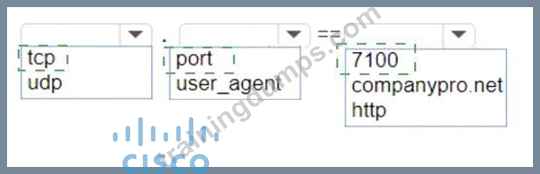
Explanation:
To capture packets sent to and received from the URL https://www.companypro.net:7100/api using Wireshark, you would use the following filter options:
* Protocol: tcp
* Filter Type: port
* Port Number: 7100
This filter setup in Wireshark will display all TCP packets that are sent to or received from port 7100, which is the port specified in the URL for the API service. Since HTTPS typically uses TCP as the transport layer protocol, filtering by TCP and the specific port number will help isolate the relevant packets for troubleshooting the app's data download issues.
* cp: The app is using HTTPS, which relies on the TCP protocol for communication.
* port: The specific port number used by the application, which in this case is 7100.
* 7100: This is the port specified in the URL (https://www.companypro.net:7100/api).
This filter will capture all TCP traffic on port 7100, allowing you to analyze the packets related to the application's data download.
References:
* Wireshark Filters: Wireshark Display Filters
NEW QUESTION # 38
An engineer configured a new VLAN named VLAN2 for the Data Center team. When the team tries to ping addresses outside VLAN2 from a computer in VLAN2, they are unable to reach them.
What should the engineer configure?
- A. Additional VLAN
- B. Static route
- C. Default gateway
- D. Default route
Answer: C
Explanation:
When devices within a VLAN are unable to reach addresses outside their VLAN, it typically indicates that they do not have a configured path to external networks. The engineer should configure a default gateway for VLAN2. The default gateway is the IP address of the router's interface that is connected to the VLAN, which will route traffic from the VLAN to other networks12.
Reference: =
* Understanding and Configuring VLAN Routing and Bridging on a Router Using the IRB Feature
* VLAN 2 not able to ping gateway - Cisco Community
* VLANs: Virtual Local Area Networks (VLANs) logically segment network traffic to improve security and performance. Devices within the same VLAN can communicate directly.
* Default Gateway: For devices in VLAN2 to communicate with devices outside their VLAN, they need a default gateway configured. The default gateway is typically a router or Layer 3 switch that routes traffic between different VLANs and subnets.
* Additional VLAN: Not needed in this scenario as the issue is related to routing traffic outside VLAN2, not creating another VLAN.
* Default Route: While a default route on the router may be necessary, the primary issue for devices within VLAN2 is to have a configured default gateway.
* Static Route: This is used on routers to manually specify routes to specific networks but does not address the need for a default gateway on the client devices.
Reference:
* Cisco VLAN Configuration Guide: Cisco VLAN Configuration
* Understanding and Configuring VLANs: VLANs Guide
NEW QUESTION # 39
Which two pieces of information should you include when you initially create a support ticket? (Choose 2.)
- A. A detailed description of the fault
- B. The description of the top-down fault-finding procedure
- C. A description of the conditions when the fault occurs
- D. Details about the computers connected to the network
- E. The actions taken to resolve the fault
Answer: A,C
Explanation:
* Statement A: "A detailed description of the fault." This is essential for support staff to understand the nature of the problem and begin troubleshooting effectively.
* Statement C: "A description of the conditions when the fault occurs." This helps in reproducing the issue and identifying patterns that might indicate the cause of the fault.
* Statement B: "Details about the computers connected to the network." While useful, this is not as immediately critical as understanding the fault itself and the conditions under which it occurs.
* Statement D: "The actions taken to resolve the fault." This is important but typically follows the initial report.
* Statement E: "The description of the top-down fault-finding procedure." This is more of a troubleshooting methodology than information typically included in an initial support ticket.
References:
* Best Practices for Submitting Support Tickets: Support Ticket Guidelines
NEW QUESTION # 40
HOTSPOT
You plan to use a network firewall to protect computers at a small office. For each statement about firewalls, select True or False.
Note: You will receive partial credit for each correct selection.
Answer:
Explanation:
Explanation:
A firewall can direct all web traffic to a specific IP address.
True: Firewalls can be configured to perform Network Address Translation (NAT) and port forwarding, which can direct all web traffic (typically on port 80 and 443) to a specific internal IP address.
A firewall can block traffic to specific ports on internal computers.
True: Firewalls can be configured with access control lists (ACLs) or rules to block traffic to specific ports on internal computers, enhancing security by restricting unwanted or harmful traffic.
A firewall can prevent specific apps from running on a computer.
False: Firewalls typically control traffic flow and do not prevent specific applications from running on a computer. Application control is usually managed by endpoint security software or application control systems.
Directing Web Traffic: Firewalls can manage traffic redirection using NAT and port forwarding rules to route web traffic to designated servers or devices within the network.
Blocking Specific Ports: Firewalls can enforce security policies by blocking or allowing traffic based on port numbers, ensuring that only permitted traffic reaches internal systems.
Application Control: While firewalls manage network traffic, preventing applications from running typically requires software specifically designed for endpoint protection and application
management.
Reference: Understanding Firewalls: Firewall Capabilities
Network Security Best Practices: Network Security Guide
NEW QUESTION # 41
You want to store files that will be accessible by every user on your network.
Which endpoint device do you need?
- A. Access point
- B. Switch
- C. Hub
- D. Server
Answer: D
Explanation:
To store files that will be accessible by every user on a network, you would need a server. A server is a computer system that provides data to other computers. It can serve data to systems on a local network (LAN) or a wide network (WAN) over the internet. In this context, a file server would be set up to store and manage files, allowing users on the network to access them from their own devices1.
References :=
* What is a Server?
* Understanding Servers and Their Functions
A server is a computer designed to process requests and deliver data to other computers over a local network or the internet. In this case, to store files that will be accessible by every user on the network, a file server is the appropriate endpoint device. It provides a centralized location for storing and managing files, allowing users to access and share files easily.
* A. Access point: Provides wireless connectivity to a network.
* C. Hub: A basic networking device that connects multiple Ethernet devices together, making them act as a single network segment.
* D. Switch: A networking device that connects devices on a computer network by using packet switching to forward data to the destination device.
Thus, the correct answer is B. Server.
References :=
* File Server Overview (Cisco)
* Server Roles in Networking (Cisco)
NEW QUESTION # 42
......
100-150 Exam Dumps - Free Demo & 365 Day Updates: https://vcecollection.trainingdumps.com/100-150-valid-vce-dumps.html
