

TrainingDumps 350-401 Real Exam Question Answers Updated [May 23, 2026]
Easily To Pass New Cisco 350-401 Dumps with 395 Questions
How to prepare for Managing Industrial Networks with Cisco Networking Technologies (IMINS) Cisco 350-401 Exam:
It doesn't matter what the candidate is doing currently. The important thing is to start preparing and getting ready for the 350-401 Exam. A lot of people have taken their exams by hiring professionals, but you should be careful about this, they can claim that they are experts, but they may be not. Moreover, learning by this source could be expensive and time taking. Hiring an expert will give you a clear idea in few days, about them and you can decide whether to hire them or not.
To go through the managing industrial network with Cisco technologies 350-401 exam it is important that you understand the subject thoroughly. For that, you need to take the help of managing industrial networks with Cisco technologies 350-401 allfreedumps material. Our expert team, carefully researched and arranged wonderful brain exam dumps to guide & prep for the exam in a very short period of time. It will be easy for you because all the major concepts like routers, switches, cameras, etc. are covered in the Managing Industrial Networks with Cisco Networking Technologies (IMINS) Cisco 350-401 Exam. Cisco 350-401 Dumps are the only source of real preparation material that is available online for Managing Industrial Networks with Cisco Networking Technologies (IMINS) Cisco 350-401 Exam. The managing industrial network with Cisco technologies 350-401 test questions will make you feel comfortable while going through them. So go through all of them and do not forget to take a printout so that you can practice more on the Managing Industrial Networks with Cisco Networking Technologies (IMINS) Cisco 350-401 Exam prep.
A Cisco Managing Industrial Networks with Cisco Networking Technologies (IMINS) 350-401 printable PDF files are available on the official website of Cisco Systems. IPV 6 is a future-proof standard, and as cloud computing becomes popularized, 350-401 exam candidates will need to know how to configure the Cisco router for IPv6.
NEW QUESTION # 194
What is the purpose of an RP in PIM?
- A. send join messages toward a multicast source SPT
- B. secure the communication channel between the multicast sender and receiver.
- C. ensure the shortest path from the multicast source to the receiver.
- D. receive IGMP joins from multicast receivers.
Answer: B
Explanation:
NEW QUESTION # 195
Refer to the exhibit.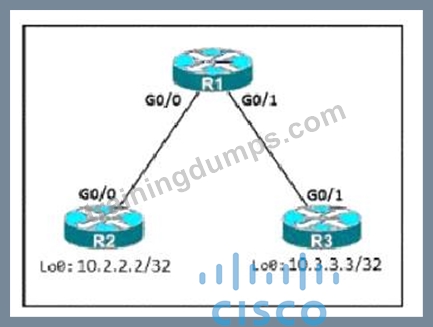
An engineer must deny Telnet traffic from the loopback interface of router R3 to the loopback interface of router R2 during the weekend hours. All other traffic between the loopback interfaces of routers R3 and R2 must be allowed at all times. Which command accomplish this task?
A)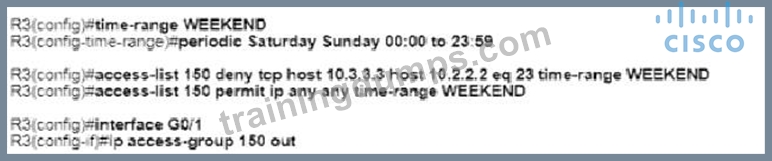
B)
C)
D)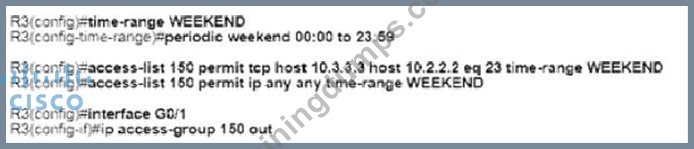
- A. Option A
- B. Option C
- C. Option B
- D. Option D
Answer: B
NEW QUESTION # 196
Drag and drop the LIPS components on the left to the correct description on the right.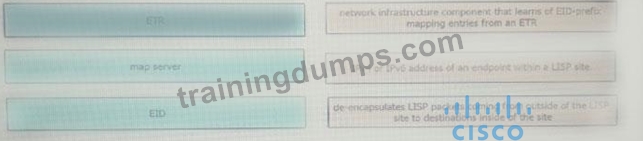
Answer:
Explanation:
* Map server
* EID
* ETR
NEW QUESTION # 197
Drag and drop the characteristics from the left onto the switching architectures on the right.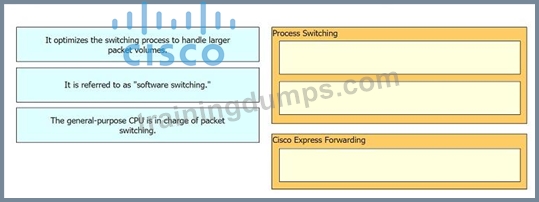
Answer:
Explanation: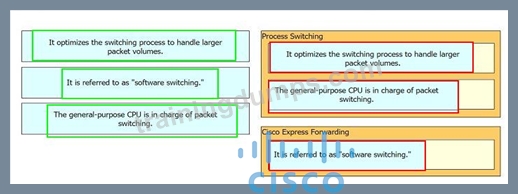
NEW QUESTION # 198
Refer to the exhibit.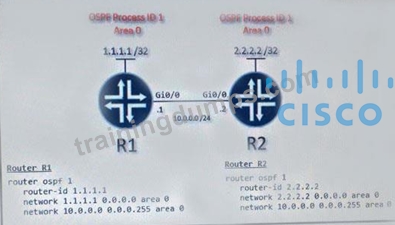
A network engineer is configuring OSPF between router R1 and router R2. The engineer must ensure that a DR/BDR election does not occur on the Gigabit Ethernet interfaces in area 0. Which configuration set accomplishes this goal?
A)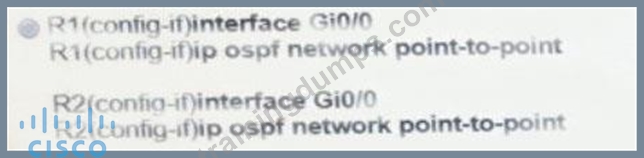
B)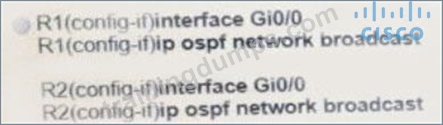
C)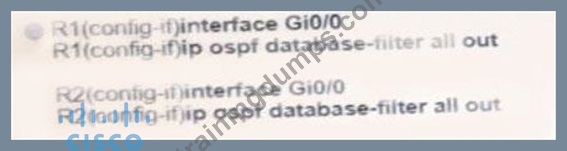
D)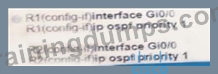
- A. Option B
- B. Option D
- C. Option C
- D. Option A
Answer: D
Explanation:
Explanation
Broadcast and Non-Broadcast networks elect DR/BDR while Point-topoint/
multipoint do not elect DR/BDR. Therefore we have to set the two Gi0/0
interfaces to point-to-point or point-to-multipoint network to ensure that a DR/BDR election does not occur.
NEW QUESTION # 199
Refer to the exhibit.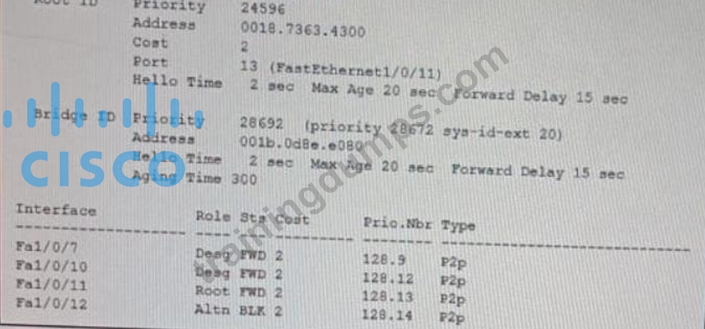
What does the output confirm about the switch's spanning tree configuration?
- A. The spanning-tree mode stp ieee command was entered on this switch
- B. The spanning-tree operation mode for this switch is PVST.
- C. The spanning-tree operation mode for this switch is IEEE
- D. The spanning-tree operation mode for this switch is PVST+.
Answer: D
Explanation:
Explanation
The default spanning-tree mode in Cisco switch is PVST+. This spanning-tree mode is based on the IEEE
802.1D standard and Cisco proprietary extensions. PVST+ is same as standard IEEE 802.1D but it runs on each VLAN. In the output we see the line "Spanning tree enabled protocol ieee" under "VLAN 20" so it can say the switch is running in PVST+ mode.
NEW QUESTION # 200
Refer to the exhibit. A GRE tunnel has been created between HQ and BR routers.
What is the tunnel IP on the HQ router?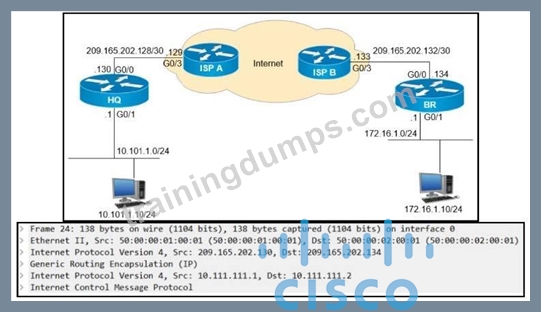
- A. 209.165.202.130
- B. 10.111.111.1
- C. 209.165.202.134
- D. 10.111.111.2
Answer: B
NEW QUESTION # 201
Refer to the exhibit.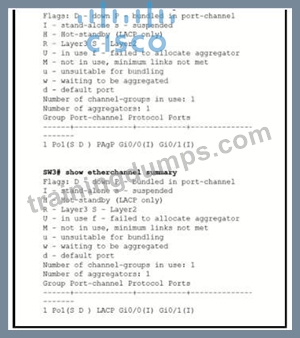
Which action resolves the EtherChannel issue between SW2 and SW3?
- A. Configure channel-group 1 mode desirable on both interfaces.
- B. Configure switchport nonegotiate on SW3
- C. Configure channel-group 1 mode active on both interfaces.
- D. Configure switchport mode trunk on SW2.
Answer: C
NEW QUESTION # 202
A Cisco Catalyst Center (formerly DNA Center) REST API sends a PUT to the
/dna/intent/api/v1/network-device endpoint. A response code of 504 is received. What does the code indicate?
- A. The user does not have authorization to access this endpoint.
- B. The response timed out based on a configured interval
- C. The username and password are not correct
- D. The web server is not available
Answer: B
Explanation:
A 504 HTTP status code indicates a Gateway Timeout. This happens when the server acting as a gateway or proxy does not receive a response from the upstream server (e.g., the backend service) within a configured timeout interval. In the context of a REST API request to Cisco Catalyst Center, this suggests that the request was processed but could not get a response in time due to server or network delays.
NEW QUESTION # 203
By default, which virtual MAC address does HSRP group 32 use?
- A. 00:00:0c:07:ac:20
- B. 05:5e:5c:ac:0c:32
- C. 00:5e:0c:07:ac:20
- D. 04:18:20:83:2e:32
Answer: A
Explanation:
The virtual IP resolves to a virtual MAC address in the format 0000.0c07.acxx, xx being the group number in hexadecimal. For example, if you use group number 3, the last part of the MAC address is ac03.
32 is in binary 0010 0000 that's mean in HEX its 2 0
NEW QUESTION # 204
What does this EEM applet event accomplish?
"event snmp oid 1.3.6.1.3.7.1.5.1.2.4.2.9 get-type next entry-op g
entry-val 75 poll-interval 5"
- A. Upon the value reaching 75%, a SNMP event is generated and sent to the trap server.
- B. It issues email when the value is greater than 75% for five polling cycles.
- C. It presents a SNMP variable that can be interrogated.
- D. It reads an SNMP variable, and when the value exceeds 75%, it triggers an action GO.
Answer: D
Explanation:
EEM offers the ability to monitor events and take informational or corrective action when the monitored events occur or reach a threshold. An EEM policy is an entity that defines an event and the actions to be taken when that event occurs. There are two types of EEM policies: an applet or a script. An applet is a simple form of policy that is defined within the CLI configuration.
To specify the event criteria for an Embedded Event Manager (EEM) applet that is run by sampling Simple Network Management Protocol (SNMP) object identifier values, use the event snmp command in applet configuration mode.
event snmp oid oid-value get-type {exact | next} entry-op operator entry-val entry-value [exit- comb {or | and}] [exit-op operator] [exit-val exit-value] [exit-time exit-time-value] poll-interval poll- int-value
+ oid: Specifies the SNMP object identifier (object ID)
+ get-type: Specifies the type of SNMP get operation to be applied to the object ID specified by the oid-value argument.
- next - Retrieves the object ID that is the alphanumeric successor to the object ID specified by the oid-value argument.
+ entry-op: Compares the contents of the current object ID with the entry value using the specified operator. If there is a match, an event is triggered and event monitoring is disabled until the exit criteria are met.
+ entry-val: Specifies the value with which the contents of the current object ID are compared to decide if an SNMP event should be raised.
+ exit-op: Compares the contents of the current object ID with the exit value using the specified operator. If there is a match, an event is triggered and event monitoring is reenabled.
+ poll-interval: Specifies the time interval between consecutive polls (in seconds) Reference: https://www.cisco.com/en/US/docs/ios/12_3t/12_3t4/feature/guide/gtioseem.html
NEW QUESTION # 205
Refer to the exhibit.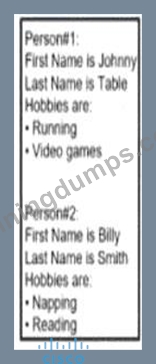
Which JSON syntax is derived from this data?
- A. Option A
- B. Option C
- C. Option B
- D. Option D
Answer: B
NEW QUESTION # 206
Refer to the exhibit.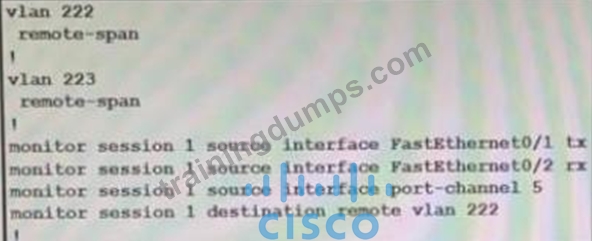
These commands have been added to the configuration of a switch Which command flags an error if it is added to this configuration?
- A. monitor session 1 source interface port-channel 6
- B. monitor session 1 source vlan 10
- C. monitor session 1 source interface port-channel 7,port-channel8
- D. monitor session 1 source interface FatEtheret0/1 x
Answer: B
NEW QUESTION # 207
Refer to the exhibit.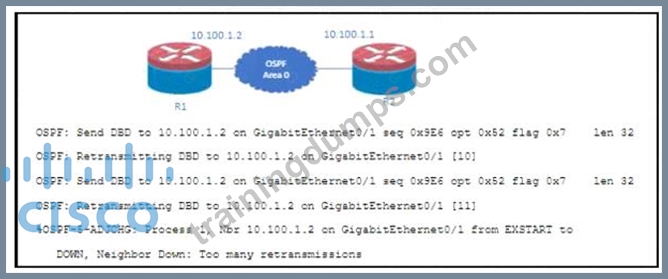
Why does OSPF fail to establish an adjacency between R1 and R2?
- A. area mismatch
- B. authentication mismatch
- C. timers mismatch
- D. interface MTU mismatch
Answer: D
NEW QUESTION # 208 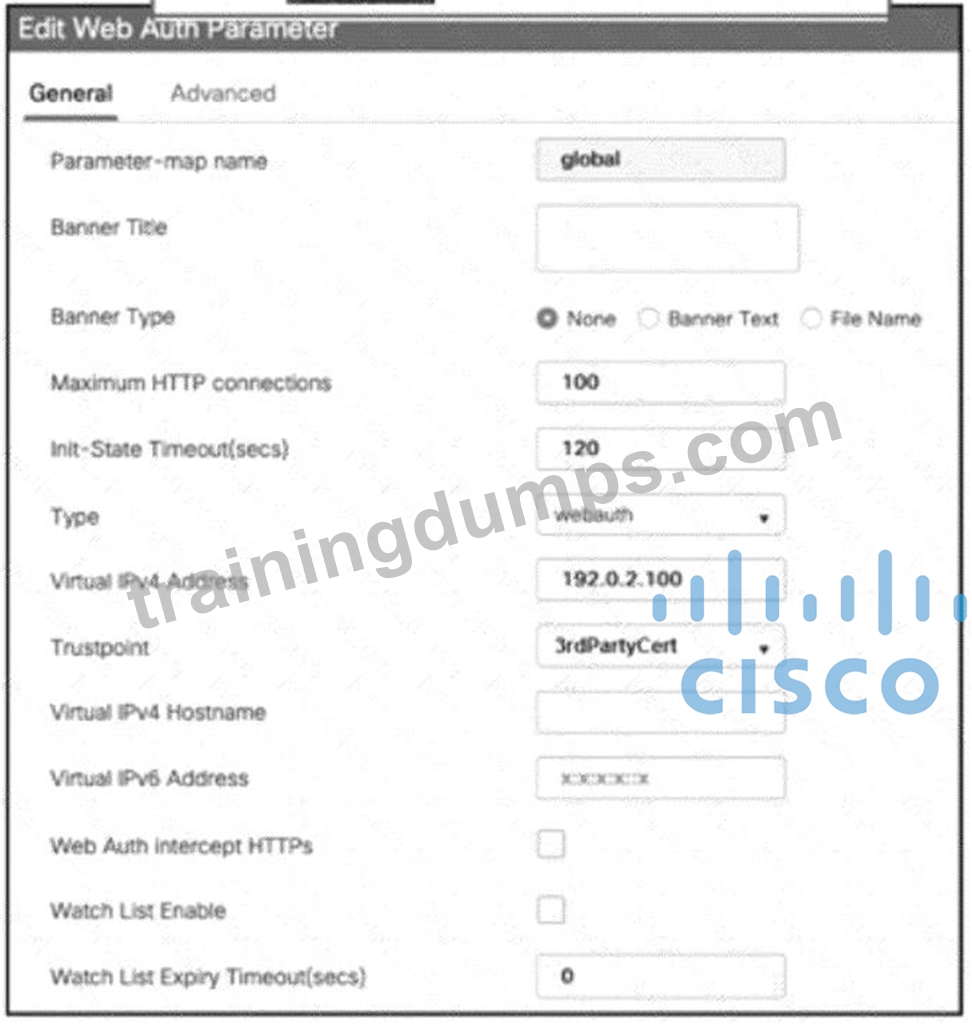
Reler to the exhibit. An engineer a configuring WebAuth on a Cisco Catalyst 9000 Series WIC. The engineer has purchased a third-party certificate using the FQDN of the WLC as the CN and intends to use bit on the WebAuth splash page What must be configured so that the clients do not receive a certificate error?
- A. Web Au!h Interoepl HTTPs must be enabled.
- B. Virtual IPv4 Address must be set to a routatte address
- C. Virtual IPv4 Hostname must match the CN of the certificate.
- D. Trustpoint must be set to the management certificate of the WLC.
Answer: C
NEW QUESTION # 209
Refer to the exhibit.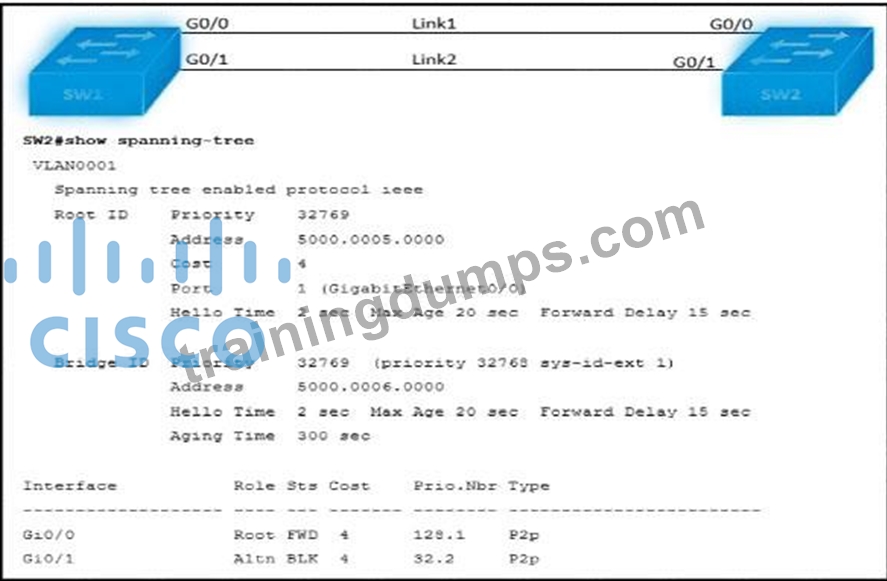
Link1 is a copper connection and Link2 is a fiber connection. The fiber port must be the primary port for all forwarding. The output of the show spanning-tree command on SW2 shows that the fiber port is blocked by spanning tree. An engineer enters the spanning- tree port-priority 32 command on GO/1 on SW2, but the port remains blocked. Which command should be entered on the ports that are connected to Link2 to resolve the issue?
- A. Enter spanning-tree port-priority 4 on SW2.
- B. Enter spanning-tree port-priority 32 on SW1.
- C. Enter spanning-tree port-priority 64 on SW2.
- D. Enter spanning-tree port-priority 224 on SW1.
Answer: B
Explanation:
Explanation
SW1 needs to block one of its ports to SW2 to avoid a bridging loop between the two switches.
Unfortunately, it blocked the fiber port Link2. But how does SW2 select its blocked port? Well, the answer is based on the BPDUs it receives from SW1. answer 'Enter spanning-tree port-priority 32 on SW1' BPDU is superior than another if it has:
1. answer 'Enter spanning-tree port-priority 32 on SW1' lower Root Bridge ID
2. answer 'Enter spanning-tree port-priority 32 on SW1' lower path cost to the Root
3. answer 'Enter spanning-tree port-priority 32 on SW1' lower Sending Bridge ID
4. answer 'Enter spanning-tree port-priority 32 on SW1' lower Sending Port ID These four parameters are examined in order. In this specific case, all the BPDUs sent by SW1 have the same Root Bridge ID, the same path cost to the Root and the same Sending Bridge ID.
The only parameter left to select the best one is the Sending Port ID (Port ID = port priority + port index). And the port index of Gi0/0 is lower than the port index of Gi0/1 so Link 1 has been chosen as the primary link.
Therefore we must change the port priority to change the primary link. The lower numerical value of port priority, the higher priority that port has. In other words, we must change the port-priority on Gi0/1 of SW1 (not on Gi0/1 of SW2) to a lower value than that of Gi0/0.
NEW QUESTION # 210
Drag and drop the characteristics from the left onto the routing protocols they describes on the right.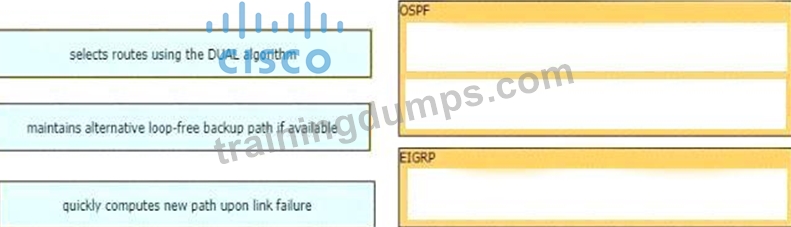
Answer:
Explanation: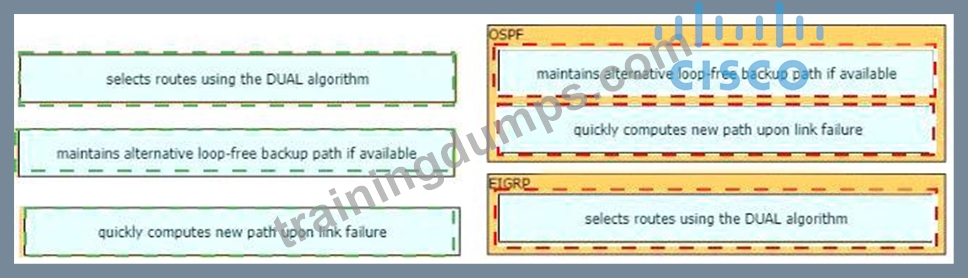
Explanation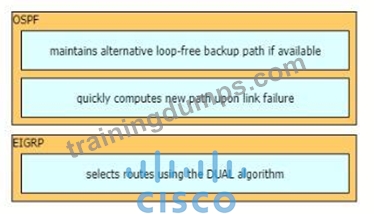
NEW QUESTION # 211
......
Cisco 350-401, also known as Implementing Cisco Enterprise Network Core Technologies (350-401 ENCOR), is a certification exam that tests candidates' knowledge of enterprise networking technologies. 350-401 exam is designed to validate a candidate's skills in implementing and troubleshooting core enterprise network technologies. Passing 350-401 exam will help candidates to earn the Cisco Certified Network Professional (CCNP) Enterprise certification.
Latest 350-401 Study Guides 2026 - With Test Engine PDF: https://vcecollection.trainingdumps.com/350-401-valid-vce-dumps.html
