

Free 2025 CTFL-AcT Dumps 100 Pass Guarantee With Latest Demo
Prepare CTFL-AcT Question Answers Free Update With 100% Exam Passing Guarantee [2025]
NEW QUESTION # 35
The standard ISO 25010 defines a quality in use model with characteristics and subcharacteristics. Which elements of the following list is a characteristic of quality in use according to this standard?
- A. Compatibility
- B. Portability
- C. Efficiency
- D. Usability
Answer: C
Explanation:
ISO/IEC 25010 defines two key quality models:
Product Quality Model (e.g., Usability, Security, Portability)
Quality in Use Model - which includes characteristics of the user's experience when interacting with the product in a real-world context.
The four main characteristics of the Quality in Use model are:
Effectiveness
Efficiency
Satisfaction
Freedom from risk
Option A - Efficiency is one of the key Quality in Use characteristics, as it refers to the resources used to achieve goals with accuracy and completeness.
Other options:
B (Usability), C (Compatibility), and D (Portability) are characteristics of the Product Quality Model, not of Quality in Use.
Therefore, the correct answer, as per ISO 25010:2011, is:
NEW QUESTION # 36
For a project to migrate an employee qualification management system to web technologies, the following requirement has been defined REQ 3-12 The system must be able to manage 3 types of users: HR team member with full rights, department manager with consultation and update rights only for members of his/her department, and employee with read-only access to his/her data Which of the following sentences BEST reflects an acceptable acceptance criterion?
- A. Security test must be performed to demonstrate that the authentication and rights management system is working properly
- B. Since I am logged in as a department manager, when I try to access the file of an employee who is not in my department then a message telling me that I do not have access rights is displayed
- C. The list of employees who are members of a department can only be updated by a person logged as HR
- D. The database must use MangoDB
Answer: B
Explanation:
Acceptance criteria should define how the system behaves for a given user story or requirement. They must be precise, testable, and directly traceable to the requirement being verified.
REQ 3-12 describes access control for three user types. Option B is a concrete, scenario-based acceptance criterion that tests the enforcement of access rights - making it an ideal match.
Other options:
A is irrelevant - database technology (MongoDB) is an implementation detail, not a functional criterion.
C is too vague - stating that security tests must be performed doesn't specify expected behavior or outcome.
D is plausible, but option B more directly demonstrates how an actual system behavior validates the requirement.
B). Since I am logged in as a department manager, when I try to access the file of an employee who is not in my department then a message telling me that I do not have access rights is displayed
NEW QUESTION # 37
During usability testing, the ergonomic of the products shall be checked. Which one of the following usability testing techniques matches this test objective BEST?
- A. Log file analysis
- B. Biometrics - based evaluation
- C. Checklist-based evaluation
- D. Walkthrough
Answer: C
Explanation:
Usability testing aims to evaluate the ease of use, efficiency, and satisfaction with which users can achieve tasks. When checking the ergonomics (e.g., layout, visual clarity, interaction comfort), checklist-based evaluations are particularly useful.
Option A is correct because a checklist of ergonomic/usability heuristics (e.g., Nielsen's heuristics, ISO 9241 standards) allows evaluators to systematically assess whether the interface meets established usability criteria.
Other options:
B (Biometrics-based evaluation) tracks physiological responses (e.g., stress or eye movement), which are useful but indirect and less targeted to ergonomic checks.
C (Walkthroughs) help assess usability by observing task flows, but they are less focused on layout and ergonomic design.
D (Log file analysis) captures behavior but not directly ergonomic issues like spacing, font size, or element alignment.
A). Checklist-based evaluation
NEW QUESTION # 38
Which of the following statements describes an advantage of bi-directional traceability between requirements
/ user stories and test cases?
- A. Business analysts can verify the completeness of the user stories / requirements with respect to business needs
- B. Testers can easily identify the source code module that most probably causes the defects observed during test execution
- C. Project managers and/or product owner can analyze the coverage of test cases for a given requirement / user story
- D. Test case reviewers can verify whether the test case covers all acceptance criteria of the linked requirement / user story
Answer: C
Explanation:
Bi-directional traceability is a fundamental concept in requirements engineering and test management. It refers to the ability to trace:
Forward: From requirements/user stories to corresponding test cases (to ensure all requirements are covered).
Backward: From test cases to the requirements they validate (to ensure every test aligns with a requirement).
According to the ISTQB Certified Tester Foundation Level and Acceptance Testing syllabi, bi-directional traceability is essential to manage test coverage and ensure completeness. It allows project managers and product owners to assess whether all specified requirements/user stories have been covered by appropriate test cases, helping to identify any untested functionality.
This also supports impact analysis during change management - knowing which test cases will be affected by a change in a requirement.
Option B is correct because it precisely captures this benefit. While Option C refers to reviewing test cases against acceptance criteria (a valid review activity), the bi-directional traceability's key benefit from a management and quality assurance perspective is traceability for coverage.
NEW QUESTION # 39
As an acceptance tester, you are stuck between two stakeholders that demand contradicting acceptance criteria Which one of the following actions is MOST promising to resolve the conflict?
- A. After having collected the pros and cons of each solutions, you base your decision on those objective criteria
- B. Together with the business analyst, you determine which stakeholders is more important to decide between them
- C. You organize a meeting of the two stakeholders so that they can solve the conflict personally
- D. Instead of discussing conflicting technical solutions, you try to understand the underlying business needs
Answer: D
Explanation:
When stakeholders provide conflicting acceptance criteria, resolving the conflict effectively requires focusing on the underlying business goals rather than getting stuck in technical or solution-level disagreements.
Option D is correct because it aligns with the core role of a business analyst and an acceptance tester: to understand and validate business needs. By exploring the root business objectives, you can help stakeholders reframe the problem and reach a compromise based on what delivers the most value.
Other options:
A may lead to confrontation and unproductive discussion without proper facilitation.
B is risky - prioritizing stakeholders may escalate conflict or appear biased.
C assumes you can objectively resolve the conflict based only on pros and cons, but without understanding the business context, the decision may not meet stakeholder needs.
D). Instead of discussing conflicting technical solutions, you try to understand the underlying business needs
NEW QUESTION # 40
Which tool is BEST for describing business processes and rules?
- A. Defect tracking tool
- B. Process modelling tool
- C. Project management tool
- D. Test management tool
Answer: B
Explanation:
To describe business processes and business rules in a structured, visual, and analyzable way, a process modeling tool is the most appropriate. These tools often support standards like BPMN (Business Process Model and Notation) for process workflows and DMN (Decision Model and Notation) for business rules.
Option D is correct because process modeling tools enable business analysts and stakeholders to capture, analyze, and communicate business operations and decision logic, which are foundational for acceptance test case generation in ATDD.
Other options:
A (Project management tools) manage schedules, resources, and scope, not business rules.
B (Test management tools) handle test cases and execution, not business modeling.
C (Defect tracking tools) track bugs but are not used for describing processes or rules.
D). Process modelling tool
NEW QUESTION # 41
As a tester on an Agile project, you have to perform an exploratory test session for a new feature developed.
Which of the following actions is the LEAST likely to be carried out for the purpose.
- A. Preparation of a test charter and review with the Product Owner
- B. Performing the tests and reporting the results
- C. Discovering and learning the use of the product
- D. Scripting of the automated test scripts
Answer: D
Explanation:
Exploratory testing is an unscripted, experience-based testing technique where the tester learns about the system, designs tests, and executes them simultaneously. It is especially effective in Agile environments, where rapid feedback and creative exploration are valuable.
Option D is the least likely action because scripting automated test scripts is a structured activity that typically occurs after exploratory sessions or during more formal test phases. Exploratory testing emphasizes manual exploration, not automation scripting.
Other options:
A is part of the core purpose of exploratory testing - discovering the product.
B is relevant - defining a charter and discussing it with stakeholders (like the Product Owner) helps guide the exploratory session.
C is also relevant - results of exploratory tests should be documented and communicated.
D). Scripting of the automated test scripts
NEW QUESTION # 42
Which one of the following statements regarding acceptance criteria is true?
- A. Acceptance criteria specify what shall be tested to verify that a requirement or user story has been implemented correctly.
- B. Testers should not be involved in writing acceptance criteria to make sure that the test is independent.
- C. In acceptance test-driven development (ATDD., acceptance criteria replace acceptance tests.
- D. Acceptance criteria are specific to agile frameworks where they correspond to functional requirements.
Answer: A
NEW QUESTION # 43
Which one of the following statements regarding ATDD / BDD is true?
- A. In both Acceptance-Test Driven Development (ATDD. and Behavior-Driven Development (BDD., test cases provide examples of product use.
- B. In both Acceptance-Test Driven Development (ATDD. and Behavior-Driven Development (BDD., acceptance test cases are written by a test automation engineer as test automation code.
- C. Behavior-Driven Development (BDD. considers acceptance test design as an activity to be handled by the test team after requirements have been finalized.
- D. In Acceptance-Test Driven Development (ATDD., test cases are written prior to the acceptance criteria.
Answer: A
NEW QUESTION # 44
Which of the following statements corresponds BEST to a UX requirement analysis activity?
- A. Personas are used to analyze products or solutions from competitors.
- B. Security requirements are derived from usage scenarios.
- C. Environmental conditions such as light conditions are obtained from a task analysis.
- D. User profiles are used to determine different levels of business knowledge.
Answer: C
Explanation:
UX (User Experience) requirement analysis involves studying the context in which users will interact with a system. This includes analyzing:
Who the users are (personas/user profiles)
What tasks they perform (task analysis)
Where and how they perform them (environmental conditions)
Option D is correct because task analysis in UX encompasses understanding the user's physical and digital environment. Environmental conditions (e.g., lighting, noise, interruptions) are important for designing accessible and effective interfaces.
Let's review other options:
A is partially correct but not fully aligned - personas describe user archetypes, not primarily competitor analysis.
B refers to user profiling but interprets it narrowly. Business knowledge is only one part of profiling.
C confuses security with UX. Security requirements often come from risk analysis, not usage scenarios.
D). Environmental conditions such as light conditions are obtained from a task analysis.
NEW QUESTION # 45
The project team is currently facing a difficult situation originating from their difficulty in envisioning the future and the necessary steps to reach it together with a certain loss of motivation due to a strong feeling of stagnation. You try to unlock the situation by proposing a workshop. Which one would fit the best?
- A. You organize a day out with challenging physical exercises practiced in teams followed by an afterwork dinner and drink. After all, nothing is best for motivation than hard times together, strong common objectives and a promise of good time.
- B. You draw a staircase with 11 steps, each of them representing a major milestone of the project. The bottom of the stairs corresponds to the first day of the project and the upper step means that the project is released. You locate the present situation in the middle of the stairs. The team is asked to identify and discuss the major steps down and up.
- C. You visualize all remaining major milestones of the project, starting with today and ending with project release. Then, you ask the team to identify and discuss the necessary actions to move forward from the present situation and to reach the milestones.
- D. You ask two volunteers to play a part in front of the team. One will try to defend the project and propose positive arguments and ways forward. The other will do the opposite. You then recapitulate the major arguments of both sides and debate them openly with the team.
Answer: B
Explanation:
In situations where a team is demotivated or struggling with vision and direction, it's effective to use visualization workshops that help the team reflect on progress and visualize a path forward.
Option B describes a metaphorical workshop using a staircase to represent the project's journey - this is known as the "Stairway Retrospective" or "Timeline Workshop". It provides a shared mental model, identifies milestones, and encourages discussion around past progress and future steps. It's ideal for reigniting motivation and clarifying direction - which aligns with the issue described in the question.
Other options:
A can spark debate but may not be constructive or motivating in a stagnation scenario.
C may foster team bonding but doesn't directly address project direction or vision.
D focuses only on future milestones and lacks the reflective component essential when a team feels stuck.
NEW QUESTION # 46
Which one of the following statements regarding performance testing is MOST correct?
- A. The performance test results serve to determine hardware and software performance requirements.
- B. The performance of the system is measured in a context that reflects, as far as possible, representative operating conditions.
- C. Performance testing aims to determine a system's robustness against malicious attacks.
- D. Depending on the model used to simulate the workload, performance tests are called load, stress or endurance / stability tests.
Answer: B
NEW QUESTION # 47
As an acceptance tester you want to test the $100 withdrawal process described by the following Business Process Model and Notation (BPMN) model.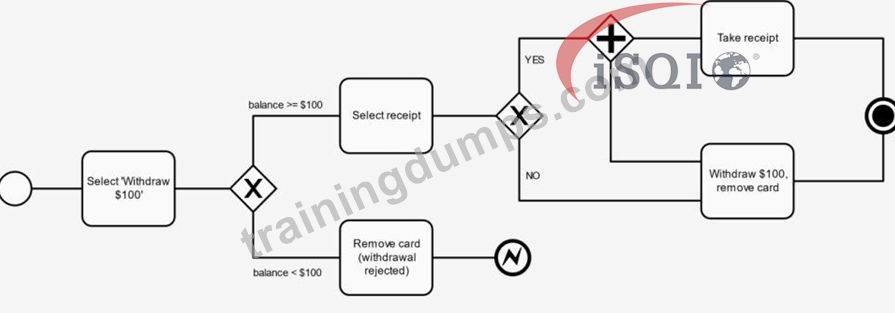
You would like to achieve the following coverage criterion "execute all possible process tasks". Consider the following test cases:
Test 1: balance = $100, receipt = YES
Test 2: balance = $120, receipt = NO
Test 3: balance = $85
Test 4: balance = $20, receipt = YES
Which of the following is the minimal set of test cases allowing to achieve required coverage?
- A. Test 1, Test 2, Test 4
- B. Test 1, Test 3
- C. Test 1, Test 2, Test 3
- D. Test 2, Test 4
Answer: B
Explanation:
Comprehensive Detailed Explanation (Approx. 200-220 words):
This question focuses on the coverage criterion "execute all possible process tasks" from the BPMN model of a $100 withdrawal.
Let's analyze the process:
The process starts when the user selects "Withdraw $100."
A decision gateway checks if the balance is # $100.
If NO: the card is removed and withdrawal is rejected.
If YES: the user is prompted to select whether they want a receipt.
Depending on the user's choice:
If YES: the receipt is printed # then $100 is withdrawn # card is removed.
If NO: $100 is withdrawn # card is removed (no receipt printed).
To meet the criterion "execute all possible process tasks," we must cover:
Rejected withdrawal path (balance < 100)
Withdrawal without receipt
Withdrawal with receipt
Receipt printing
Card removal in both success and failure
Test case coverage:
Test 1 (balance = $100, receipt = YES): covers successful withdrawal + receipt printed.
Test 3 (balance = $85): covers withdrawal rejected + card removed.
Together, these two tests execute all possible process tasks:
Withdraw with receipt
Reject due to insufficient balance
Receipt printed
Withdraw funds
Remove card
Other test combinations are redundant or do not add new path coverage.
NEW QUESTION # 48
Your company wants to establish a new human resources management application. As tester, you propose to use an ATDD approach and to use business process models for test case design.
Which of the following statements is the LEAST meaningful argument for this approach?
- A. Business process models will make it easier to detect defects in the application code.
- B. The process models will help testers to understand the use cases to be tested.
- C. As business process models will be updated to maintain the tests, they will be a living documentation of the product.
- D. Testers will be able to show test coverage directly within the graphical representation of business processes.
Answer: A
NEW QUESTION # 49
Which one of the following statements regarding the graphical representation of business processes is true?
- A. Using decision tables in BPMN allows defining test conditions corresponding to the business rules under test.
- B. Graphical representations of business processes must describe the complete workflow in detail, including alternative and error scenarios.
- C. Business processes should be described graphically using the DMN standard and completed with decision tables.
- D. For acceptance testing, graphical business process models should focus on the user workflows to be tested.
Answer: D
Explanation:
Graphical representations of business processes, particularly using BPMN (Business Process Model and Notation), serve as a bridge between business stakeholders and testers. These models help visualize the steps a user or system goes through, making it easier to derive test cases.
Option C is correct because acceptance testing aims to validate the system's behavior from the user or business perspective. Therefore, focusing on key user workflows (rather than exhaustive technical or exception paths) aligns with the purpose of acceptance testing: to ensure that the system meets agreed-upon business requirements.
Option A is incorrect because decision tables are part of DMN (Decision Model and Notation), not BPMN.
Option B is too rigid - not all alternative/error paths must be modeled in early acceptance testing unless they are critical to business rules.
Option D misapplies the standards - DMN is used to model business rules, not the complete business process.
C). For acceptance testing, graphical business process models should focus on the user workflows to be tested.
NEW QUESTION # 50
Which one of the following statements describes an exploratory test charter BEST?
- A. Each exploratory test charter is based on a previously defined list of activities that would be interesting to test.
- B. Acceptance testers use the exploratory test charter during the testing session to define the test oracle.
- C. Indicating that the tester should take the role of a novice user can be part of an exploratory test charter.
- D. The test charter is elaborated during the testing session according to test execution results.
Answer: C
Explanation:
An exploratory test charter is a high-level plan or mission statement for a time-boxed exploratory testing session. It guides what the tester should focus on during the session and may include the goal of the test, specific areas of the system under test, the risk or feature to explore, the type of persona to simulate (e.g., novice or expert user), and possibly known issues to watch out for.
Option A is correct because specifying a user persona (such as a novice user) helps the tester approach the system from that perspective. This supports the goal of exploratory testing: to simulate realistic usage and uncover issues that scripted tests might miss.
Option B is incorrect - although exploratory testing is adaptive, the charter is defined before the session starts, not elaborated during execution.
Option C is misleading - charters may refer to areas of interest, but not necessarily to a predefined list of activities.
Option D is incorrect - a test oracle (i.e., the mechanism for determining whether a result is correct) is not defined by the charter. It may exist already or be inferred from requirements, heuristics, or user expectations.
Exact Reference - ISTQB CTFL Acceptance Testing Syllabus (Section 3.1):
"Charters define the focus of exploratory testing sessions and may specify the tester's role or perspective (e.
g., novice user)."
NEW QUESTION # 51
Which of the following information is most likely part of an acceptance test summary report?
- A. Test procedure information.
- B. Information to evaluate the level of risk for product release.
- C. Technical details on defect fixes.
- D. Test strategy and test design methods.
Answer: B
Explanation:
An acceptance test summary report is a high-level document produced at the end of acceptance testing. It provides stakeholders (especially business owners and decision-makers) with essential information to determine whether the system meets the acceptance criteria and whether it is ready for release.
Option A is correct because understanding the residual risk - based on test results, open defects, and coverage - is critical for release decisions. The summary report includes test execution status, significant findings, defect summaries, and an overall risk assessment.
Other options:
B (technical details on defect fixes) belong more in defect or technical reports, not in the acceptance summary.
C (test strategy/design methods) are part of the test plan, not the summary report.
D (test procedure info) is operational detail, not suited for a high-level summary report.
A). Information to evaluate the level of risk for product release.
NEW QUESTION # 52
Which of the following statements regarding defects is MOST correct?
- A. If the defect turns out to be a bug, the tester writes a defect report and sends it to the business analyst for further investigation.
- B. The tester should analyze the potential impact of a defect on system usage, before communicating it to the business analyst.
- C. Regular meetings between business analysts and testers are necessary to report discrepancies between actual and expected outcome.
- D. Testers should provide accurate information regarding the difference between the expected test result and the actual result.
Answer: D
Explanation:
Defect reporting is a core responsibility of testers. When a test fails, the tester must document the observed behavior and how it differs from the expected behavior. This allows developers, analysts, and stakeholders to assess whether the issue is a defect, and if so, prioritize and fix it.
Option B is correct because it accurately describes the core responsibility of a tester when logging a defect:
report the mismatch between actual and expected outcomes clearly and objectively.
Other options:
A refers to meetings, which are useful but not a replacement for clear defect reports.
C incorrectly assigns the role of defect routing to business analysts - this is typically handled by test or defect management tools.
D suggests the tester analyzes impact before reporting - which could delay the defect being logged and is not always the tester's role (impact analysis is often done collaboratively later).
B). Testers should provide accurate information regarding the difference between the expected test result and the actual result.
NEW QUESTION # 53
Which of the following techniques is most likely applied to ensure the quality of acceptance testing activities?
- A. Checklist-based verification of requirements to ensure their completeness and quality.
- B. Verification of the traceability between user stories and test cases to make sure it is up to date.
- C. Review of the source code to ensure traceability of user stories to system components.
- D. Eye tracking to verify the feasibility of previously defined user acceptance tests.
Answer: B
NEW QUESTION # 54
......
Dumps Real ISQI CTFL-AcT Exam Questions [Updated 2025]: https://vcecollection.trainingdumps.com/CTFL-AcT-valid-vce-dumps.html
